
Chat with Ava - Your AI Business Consultant

Hi I'm Ava, your AI guide to supercharging your business!
Whether you're already running a business or dreaming of starting one, I'm here to help turn your vision into reality using AI powered freelancers. Share your business goals, and together, we'll create a project that our talented freelancers can bid on. Let's make your vision a reality!
I have a business
I'm starting a business
Something went wrong while sending the conversation to your email. Please try again later.
You can only save your conversation once per hour. Please try again later.
Your conversation is too short. Keep chatting with Ava to enable saving.
Carl Breau: How to know when you're scaling too quickly
Most startups fail because they scale too quickly. Carl Breau shares his insights on how this can be avoided ASAP.
Dec 18, 2019 • 3 minute read
E
Closed User
Copy to clipboard failed, please try again after adjusting your permissions.
Copied to clipboard.
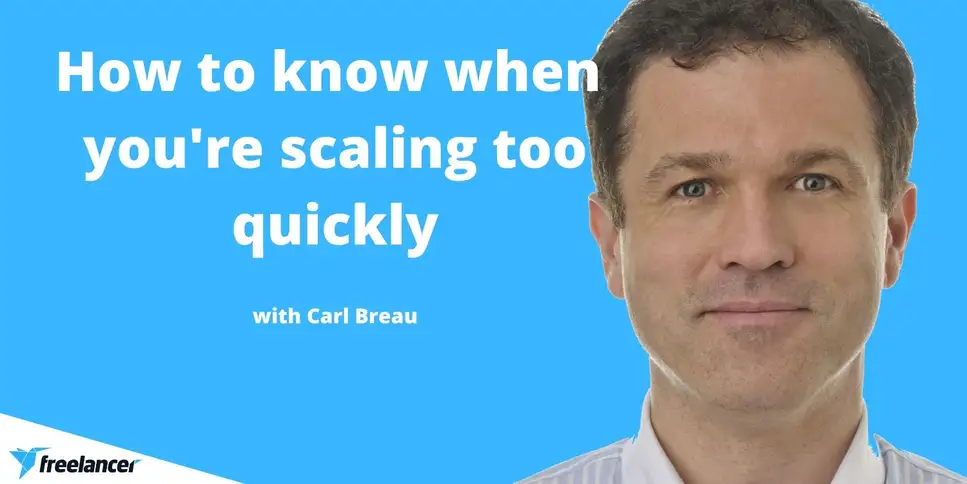
Worried about scaling your startup too quickly? You should be.
Scaling too quickly is one of the #1 causes of startup failure . If you notice the warning signs early enough, you'll dramatically increase the chances of your startup flourishing.
At Startcon 2019, we sat down with Carl Breau, CEO of Saimen , to discuss his insights on the problems of startups scaling prematurely.
Startups are under pressure to scale
Business owners are living in an amazing age. Now in just a few mouse clicks, you can place your brand in front of millions of people, and even get them to fund your venture. Crowdfunding could completely disrupt the VC world by giving any startup the opportunity of funding, without relinquishing capital.
But like all things that seem too good to be true, they usually are. Carl says that successful crowdfunding campaigns often put a lot of pressure on startups to meet the growth milestones they promise to their backers.
"There is so much pressure, especially on startups to scale too quickly." Carl says, "And many things are contributing to that. For example, crowdfunding. It's a great platform but it immediately creates a lot of pressure on you to meet deadlines and deliver quickly."
The most effective crowdfunding campaigns incentivize fundraising by rewarding their backers. The more you give, the greater the reward value. This can easily blow out of control if a campaign is successful. There's so much pressure to deliver these rewards, and to continuously prove that your venture is actually growing with regular updates to your backers.
But crowdfunding platforms aren't the only startup pressure cookers. Accepting funding from the wrong investors places an incredible amount of pressure on startups to scale and become profitable ASAP.
Learn to let things go
When the time comes to start scaling, many founders don't understand how to strategically grow their team , so they end up doing too much of the work themselves. No startup founder was born with superpowers, so it's OK to admit you can't do something.
"A lot of entrepreneurs are talented in things like marketing and product development but they don't fully realised how to scale products," Carl says.
Carl encourages startup owners to outsource peripheral jobs so that they don't have to do everything themselves.
"There's always that balance when you're a startup of identifying what you should be working on and what you should outsource to others," he says.
To help you make that distinction, Carl suggests that you keep all tasks linked to Project Intellectual Property (PIP) in-house and outsource any secondary work.
"Typically, if it's very PIP, you want to keep it internal as much as possible. Freelancers are great for doing secondary work."
Outsourcing solutions have evolved to become very supportive of growing startups. Now startup founders can flex their operations by tapping into just about any talent at any time, for however long they need it, and all without the burden of hiring full-time employees.
Solutions like Technical Co-pilot allow Startup founders to completely outsource the management of their freelancer workforce to a project manager who can even scale the operations for them.
Raising startup funds via a crowdfunding campaign is a great option, if you have a supportive framework for your scaling efforts.
By identifying when you should scale and being open to outsource secondary work to others, you can prevent your startup form scaling prematurely and becoming a 2020 statistic.
Tell us what you need done
Enter your project name
Related Stories





Talk to one of our Technical Co-Pilots to help with your project
Recommended Articles Just for You

If your creativity needs a jump start follow Dr Christyl Johnson's tips to get back on track fast
4 min read

We spoke to the managing partner of a VC firm about the sort of startup pitches that grab investors' attention. Here's what he said.
3 min read

Before you try to build the digital product of your dreams, you need to start with an MVP. We'll tell you why, and how to build one.
8 min read

Growing your business on instagram is touch, but it's not impossible. Follow our guide to learn how you can this platform to grow your business.
8 min read
Thanks! We’ve emailed you a link to claim your free credit.
Something went wrong while sending your email. Please try again.



Copy to clipboard failed, please try again after adjusting your permissions.
Copied to clipboard.
Loading preview
Permission granted for Geolocation.
Your login session has expired and you have been logged out. Please log in again.